Terahertz(THz) waves, spanning frequencies from 0.1 to 10 THz, offer abundant spectral resources and the potential for ultrahigh bandwidth, and are widely regarded as an important technological foundation for future sixth-generation wireless communications. To meet the demands of intelligent communications, future wireless systems must not only support high-speed data transmission, but also perceive changes in the environment and autonomously adapt the way signals are transmitted.In recent years, intelligent metasurfaces have emerged as an important platform for constructing smart wireless environments because of their ability to flexibly manipulate the propagation direction of electromagnetic waves. However, most existing intelligent metasurfaces operate according to predefined control schemes and lack the ability to autonomously sense their surrounding electromagnetic environment. As a result, they cannot readily adjust their beams in response to changes in user position or propagation conditions. Enabling intelligent metasurfaces to integrate both sensing and control capabilities, and to autonomously reconfigure their beams according to environmental changes, therefore represents a key challenge for the future convergence of communication and sensing in 6G systems.
To address this challenge, a research team led by Professors Biaobing Jin and Jingbo Wu from Academician Peiheng Wu’s group at the Research Institute of Superconductor Electronics, Nanjing University, in collaboration with Professor Cheng-Wei Qiu’s group at the National University of Singapore, has proposed and experimentally demonstrated a THz intelligent metasurface capable of sensing the direction of incident electromagnetic waves.Based on a VO2–metal hybrid metasurface architecture, the device integrates THz direction-of-arrival detection, frequency identification, and dynamic beam control within a single platform. It can sense changes in the incident electromagnetic field and actively redirect the reflected beam according to the measured information. Compared with the team’s previously reported THz intelligent metasurface, published in Science Advances in 2022(Science Advances 8,eadd1296, 2022), the present work moves beyond sensing only signal intensity and enables direct identification of the incident-wave direction. This represents an important step toward transforming intelligent metasurfaces from passive-response devices into systems capable of perceiving their environment and autonomously controlling electromagnetic waves.
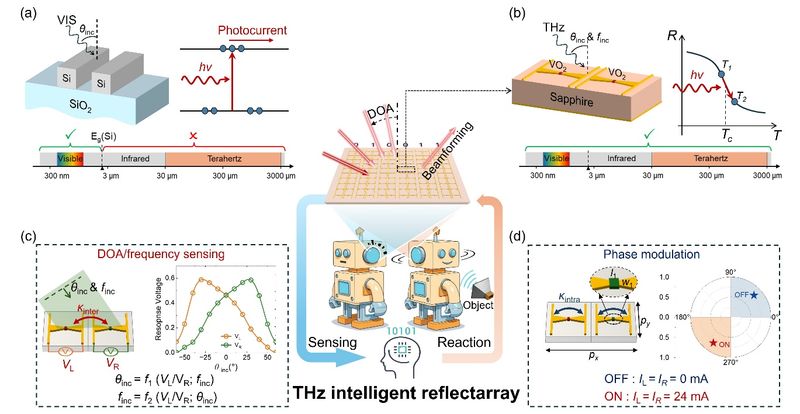
Figure 1. Operating principle of the THz intelligent reflectarray. Inter-element coupling is used to sense the direction and frequency of the incident THz wave, while the phase transition of vanadium dioxide (VO2) is employed to control the reflection phase, thereby enabling dynamic beam manipulation.
Conventional direction-of-arrival detection generally relies on an array of multiple sensing elements and determines the source direction by comparing the signals received at different spatial positions. At THz frequencies, however, realizing compact and highly integrated direction sensing remains challenging.On the one hand, conventional semiconductor detectors usually rely on photogenerated carrier mechanisms. Because THz photons have relatively low energies, they cannot readily excite effective photoelectric responses in materials such as silicon. On the other hand, converting the spatial directional information carried by THz waves into directly measurable electrical signals is another major challenge for on-chip sensing.
To overcome these limitations, the research team designed a VO2-metal hybrid array based on non-Hermitian coupling. The key idea is to exploit coupling between neighboring elements to convert the direction and frequency of an incident THz wave into spatially differentiated responses among individual meta-atoms, thereby allowing the source direction to be identified.At the same time, the large conductivity contrast associated with the insulator-to-metal phase transition of VO2 enables THz-wave information to be directly read out through resistance variations, circumventing the bandgap-related limitations of conventional semiconductor materials. The researchers further used intra-element coupling to modulate the reflection phase and achieve dynamic beam steering.In this sense, the device functions like a “THz intelligent ear”.It can determine where an THz wave is coming from and then adjust the reflected beam according to the sensing result, thereby integrating THz sensing and control in a single platform.
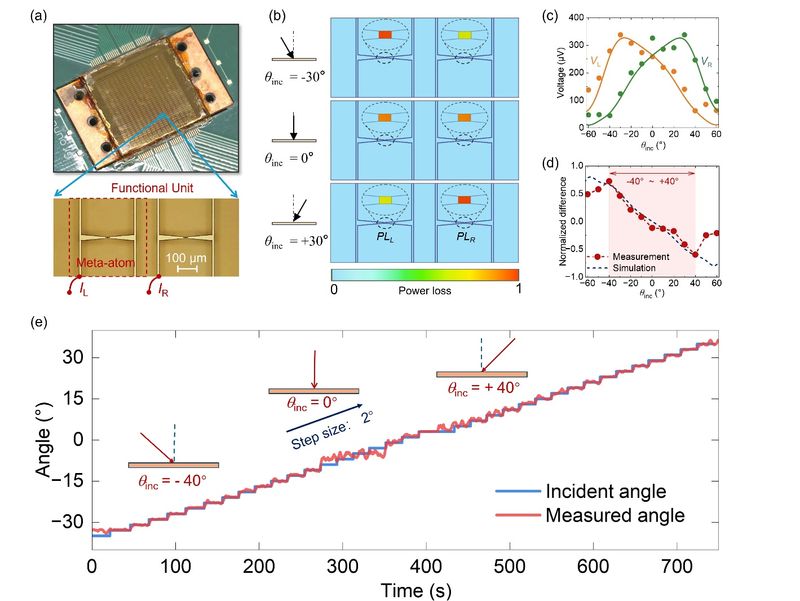
Figure 2. Direction sensing of an incident THz wave using the intelligent metasurface. A single functional element can identify the direction of the incident wave and provide real-time feedback for subsequent dynamic beam control.
In the experimental study, the researchers fabricated a prototype THz intelligent metasurface and systematically characterized its direction-sensing, frequency-identification, and beam-control capabilities.At an operating frequency of 185 GHz, the device achieved an average incident-angle detection accuracy of approximately 2°, enabling reliable identification of the direction of the incoming THz wave, as shown in Figure 2. By electrically switching the coding states of the metasurface, the reflected beam could also be flexibly redirected. The experimentally measured beam directions agreed closely with the theoretical designs, with the deviation of the main-lobe angle remaining below 2°.
The team further constructed an adaptive beam-tracking demonstration system. When the THz transmitter, representing a moving terminal, changed its position, the intelligent reflectarray sensed the resulting variation in the incident direction and automatically updated its control state. The reflected beam was then redirected toward a fixed receiver. This experiment demonstrated a closed-loop operating mode in which electromagnetic sensing directly drives beam control.
In addition, the device can identify the frequency of an incident THz wave. When the incident frequency changes, the coupling state within the functional unit varies accordingly, producing measurable differences in the device response. Experimental results showed that the metasurface achieved a frequency resolution better than 1 GHz over the range from 180 to 188 GHz, as shown in Figure 3.
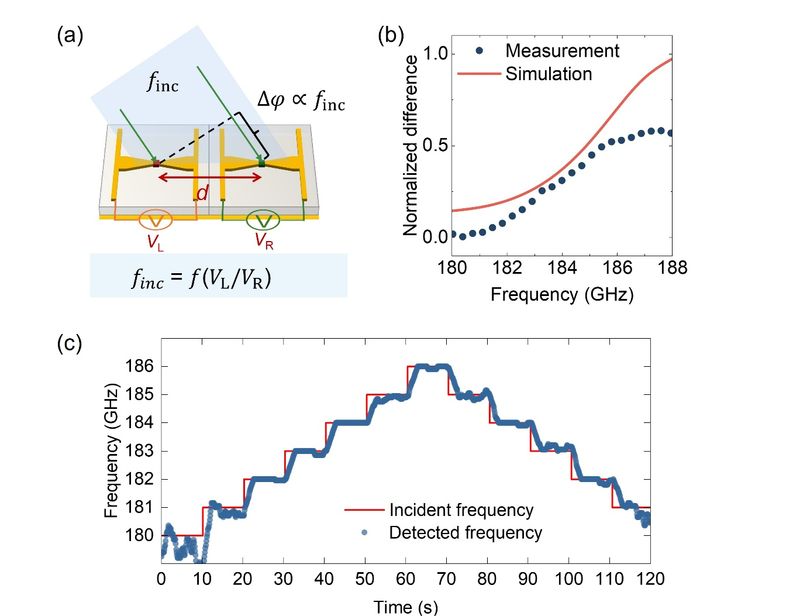
Figure 3. Frequency sensing using the THz intelligent metasurface. Variations in the coupled response allow the device to dynamically identify the frequency of an incident THz wave, achieving a resolution better than 1 GHz over the 180–188 GHz range.
This work establishes a THz intelligent metasurface architecture that integrates sensing and electromagnetic-wave control. By realizing direction-of-arrival detection and autonomous beam steering without additional external detectors, the study provides a new technological route toward highly integrated and intelligent THz electromagnetic systems. Such devices may find future applications in 6G communications, intelligent sensing, autonomous navigation, and multidimensional electromagnetic information processing.
The research article, entitled “Terahertz intelligent reflectarray for direction-of-arrival detection and phase modulation,” has been published in Optica. Benwen Chen and Hangbing Guo from Nanjing University, together with Chi Wang from the National University of Singapore, are co-first authors of the paper. Professors Jingbo Wu, Cheng-Wei Qiu, and Biaobing Jin are the corresponding authors. Professors Yunbin He and Associate Professor Jian Chen from Wuhan Textile University provided important support for the study. Academician Peiheng Wu, Professors Jian Chen, Huabing Wang, and Caihong Zhang, and Associate Professor Kebin Fan from Nanjing University, together with Researcher Wei Tan from the China Academy of Engineering Physics and Professors Chi Hou Chan and Geng-Bo Wu from City University of Hong Kong, provided valuable guidance and assistance.The research was supported by the National Natural Science Foundation of China, the Jiangsu Provincial Fund for Distinguished Young Scholars, the Natural Science Foundation of Jiangsu Province, the Fundamental Research Funds for the Central Universities, and the Jiangsu Key Laboratory of Advanced Electromagnetic Wave Manipulation Technology.
Paper link:
Terahertz intelligent reflectarray for direction-of-arrival detection and phase modulation